How to do a One-Handed Backhand in Tennis
Updated: Apr 28, 2024
A one-handed backhand in tennis is a stroke executed with just one hand on the racquet, typically the dominant hand, when hitting a backhand shot. For example, a right-handed player would use their right hand to hit a one-handed backhand shot.
The one-handed backhand differs from the two-handed backhand, where the player uses both hands on the racquet during the swing. The choice between a one-handed and two-handed backhand often depends on player preference, comfort, and playing style.
Players who use a one-handed backhand often value the reach and versatility it offers. However, it can require more strength and timing to execute effectively compared to the two-handed backhand. Additionally, some players find it more challenging to generate power and control on high balls with a one-handed backhand.
Nevertheless, many professional players, past and present, have excelled with the one-handed backhand, demonstrating its effectiveness at the highest levels of the sport. It remains a beautiful and distinctive shot in tennis, celebrated for its grace and technical precision.
Mastering the one-handed backhand in tennis requires proper technique and practice. Here's a step-by-step guide on how to execute a one-handed backhand:
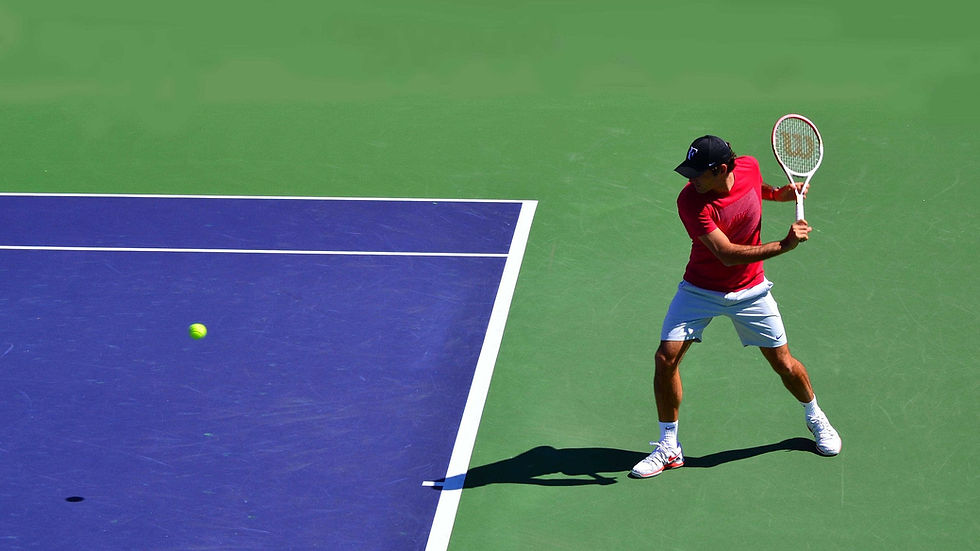
Grip: Hold the tennis racket with an Eastern backhand grip. This grip involves placing your index knuckle on bevel number 1 (for right-handed players) or bevel number 8 (for left-handed players). Your grip should allow you to comfortably control the racket while still generating power and spin.
Stance: Stand sideways to the net with your non-dominant side facing the net. Your feet should be shoulder-width apart, with your knees slightly bent to provide stability and agility.
Ready Position: Hold the racket with your non-dominant hand placed near the bottom of the handle and your dominant hand positioned slightly above it. Keep your arms relaxed and your racket head slightly higher than your grip level, ready to react to the incoming ball.
Backswing: As the ball approaches, initiate your swing by turning your shoulders and hips while bringing the racket back. Your racket should be pointing upwards, with your non-dominant hand guiding the racket head.
Contact Point: As the ball reaches the ideal hitting zone, slightly in front of your body and around waist height, extend your dominant arm and make contact with the ball. The contact should be in front of your body and slightly to the side, depending on your preferred style.
Follow-through: After making contact, continue the swing across your body. Your racket should finish high, over your opposite shoulder. This follow-through generates power and spin on your backhand shot.
Footwork: Use your feet to adjust your position and maintain balance throughout the stroke. Step into the shot with your front foot, transferring your weight forward, and pivot on your back foot as you rotate your body.
Topspin: To add topspin to your one-handed backhand, focus on brushing up on the back of the ball at contact. This action creates a forward rotation, causing the ball to dip down into the court after crossing the net.
Recovery: After completing your stroke, quickly recover to a neutral position to prepare for your next shot. Return to the ready position with your racket up and your body balanced, ready to move in any direction.
Practice: Like any tennis skill, mastering the one-handed backhand takes practice. Start with slow, controlled swings and gradually increase your speed and power as you become more comfortable with the technique.
By following these steps and practicing regularly, you can develop a strong and effective one-handed backhand to add to your tennis repertoire.
To learn more about mastering the one-handed backhand in tennis schedule a private lesson with Potomac Tennis Pro.


